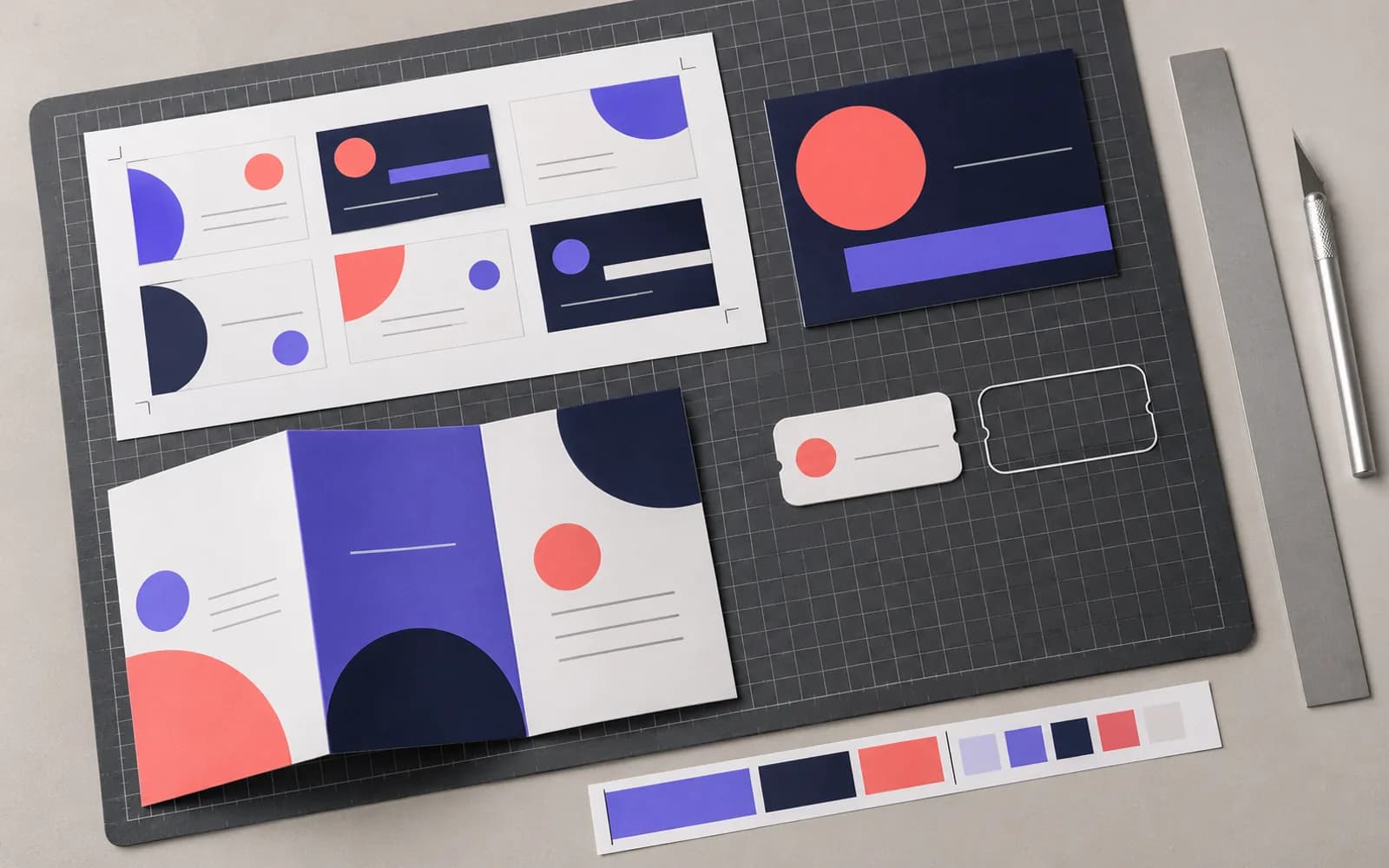
Graphic design services for Australian businesses.
Send a brief and it goes to an experienced Australian brand design studio, which quotes on your actual scope. We do not design anything ourselves. What this page does is help you brief the work properly and read the quote you get back.
Graphic design services are the ongoing production of a business's visual materials: collateral, print, digital, signage artwork and campaign assets, made to a brand system rather than invented again each time. This page sets out 9 categories of that work, what each one hands over, and the 6 things that move a quote. As a planning frame only, single pieces commonly start near $200 and a standing monthly arrangement can run to $6,000 or more. Those are planning figures, not survey data.
Get your free quote
Takes under 2 minutes.
Graphic design services, and the 9 jobs hiding inside the phrase.
Graphic design services is a broad term, and that breadth is the first problem when you go to buy it. The phrase covers the person who lays out a 40-page tender response, the person who draws artwork for a shopfront sign, and the person who takes 1 campaign idea and rebuilds it in 14 sizes. Those are 3 different skill sets, 3 different quotes and, often enough, 3 different people. The fastest way to get a price you can act on is to say which of the categories below you actually need.
It also helps to know where graphic design stops. Brand design builds the system: how the business looks and holds together across everything it produces. Logo design produces the single mark at the centre of it. Brand guidelines write the rules down so the system survives contact with other people. Graphic design services are what happens after all of that: applying the system to real jobs with real deadlines. If there is no system yet, a graphic designer ends up inventing one job by job, and you pay for that decision twice.
| Category | What you receive | What moves the price |
|---|---|---|
| Marketing collateral | Brochures, flyers, rack cards, one-pagers, capability statements and price lists, supplied as press-ready artwork. | Page count, whether the copy is written, and how much of it is repeated layout. |
| Sales and pitch documents | Pitch decks, proposals and tender responses, usually as an editable template plus a designed example. | Whether you need to edit it yourself afterwards, and how many charts and tables are in it. |
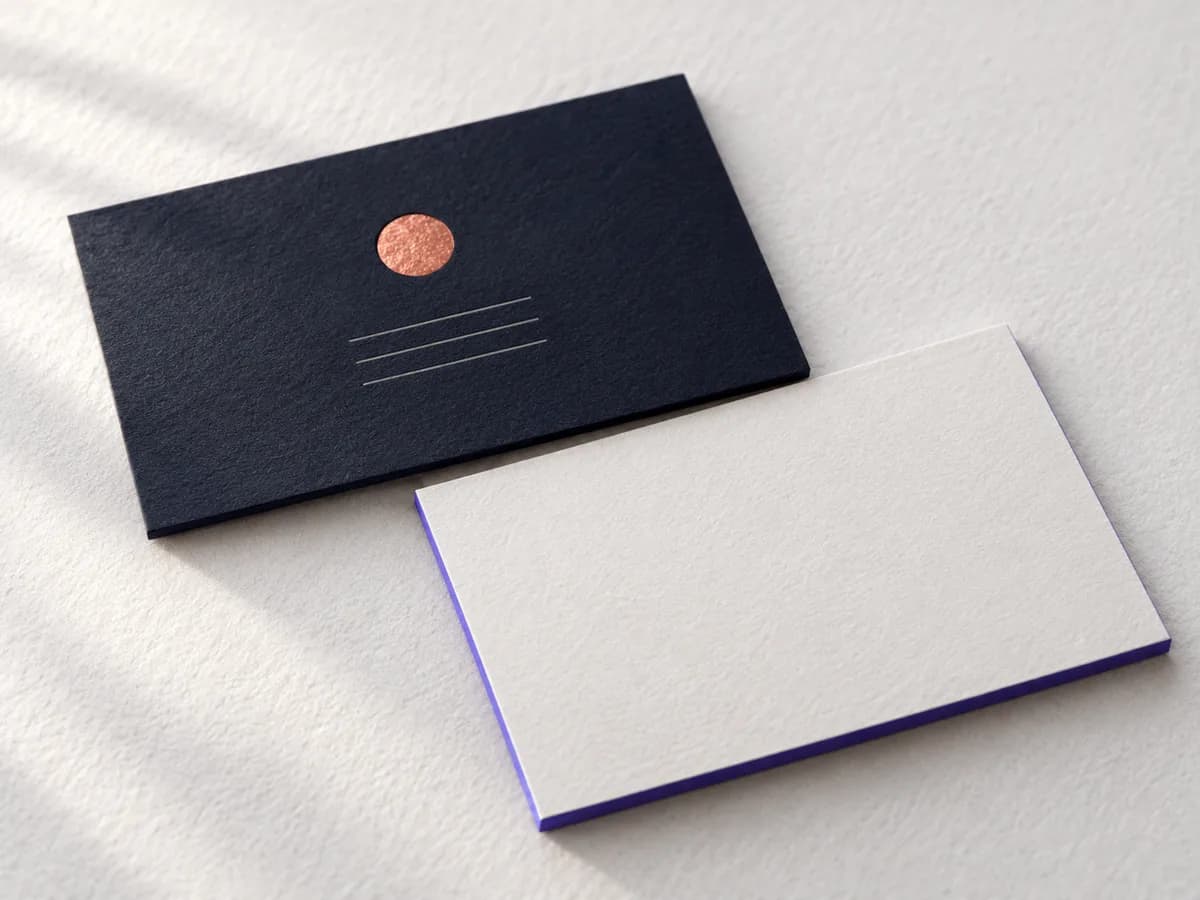
| Business cards and stationery | Cards, letterhead, with-compliments slips, envelopes and email signatures set on a single grid. | Finishes such as foil or spot gloss, and how many staff variants are needed. |
| Signage artwork | Vector artwork and a specification for the sign maker, not the sign itself. | How many sign types, and whether a site survey has already fixed the dimensions. |
| Packaging and labels | Dielines, label artwork and any regulated panel laid out to the printer's template. | Number of product variants, and how many of them share one layout. |
| Social and digital assets | Post and story templates at the correct pixel dimensions, plus a set of built examples. | How many platforms, and whether you need editable templates or finished files only. |
| Email and web graphics | Campaign email layouts, banners, landing page graphics and icon sets. | Whether it is designed only, or built and tested in an email platform as well. |
| Reports and data visualisation | Annual reports, impact reports, infographics and chart systems built on your type and colour. | How much data there is, and how final it is when the layout starts. |
| Advertising and campaign assets | A campaign idea taken across the sizes it needs: press, outdoor, digital display and social. | The number of formats. Resizing is the bulk of the work on most campaigns. |
Very few businesses need all 9 at once. Most need 2 or 3 well, and the rest either never or once a year. Being specific about which ones is worth more to your quote than any amount of description about the business.
A finished job is a set of files, not a picture in an email.
This is the part of the transaction that is easiest to skip, and it is where money gets quietly lost. A design that looks right on screen can still be unusable: the wrong colour mode for the press, no bleed, raster artwork sent to a machine that only cuts vector, or a layout you cannot edit without paying for a change request every time a phone number moves. Ask what you will be handed before you approve anything, and measure the answer against the table below.
| Where it ends up | Colour and resolution | Formats to ask for | Why it matters |
|---|---|---|---|
| Offset or digital print | CMYK, 300 ppi at final size | Press-ready PDF (PDF/X-1a or PDF/X-4) with 3 mm bleed and crop marks | Australian printers generally ask for 3 mm bleed. Artwork built to the trim line gives you a white sliver on the cut edge or a reprint. |
| Large-format print | CMYK, roughly 100 to 150 ppi at final size | PDF or packaged vector artwork, often supplied at a stated scale such as 1:10 | A 3 m banner at 300 ppi is roughly 35,000 pixels wide, and that detail buys nothing at the distance the banner is read from. |
| Signage and vehicle graphics | Vector, with spot colour or vinyl swatch references | AI, EPS or vector PDF, usually placed on the fabricator's own template | Cut vinyl and routed letters are made from paths. A raster logo cannot be cut, only printed. |
| Embroidery on uniforms | Reduced colour count, minimum detail size | A digitised stitch file (DST is the common one) alongside the vector logo | Digitising is a separate step done by the embroiderer. Your artwork file is not a stitch file. |
| Screen and web | RGB | SVG for marks and line art, PNG or WEBP for everything else, exported at 1x and 2x | An SVG stays sharp at any size. A 400 px PNG scaled up on a high-density screen looks soft. |
| Documents you edit yourself | RGB, office software | Word, PowerPoint or Google Slides templates built on real styles and master slides | A template made of pasted images is a document you will pay someone else to update every time. |
| Working files | Not applicable | Packaged InDesign, Illustrator or Photoshop files, or the Figma file, with fonts and links collected | Without them the next change starts from scratch. Ownership and licensing sit in your designer's own agreement, so settle it before work starts. |
There is a further trap worth knowing about: fonts are licensed, not owned. A desktop licence covers a designer setting your brochure. It does not automatically cover serving that font on a website, embedding it in an app, or handing it to a third party to use. Ask which fonts a layout depends on and whether your licence covers what you intend to do with it, because discovering the gap later means either buying the licence at that point or resetting the material in a different typeface.
If you want a plain-language version of how these pieces fit together into an identity, the guide on what brand identity actually means covers the vocabulary without the jargon.
Business cards, stationery and printed collateral.
A business card is the smallest brief on this page and one of the most frequently got wrong, because the constraints are physical rather than aesthetic. In Australia the standard card is 90 x 55 mm. That is a different shape from the 85 x 55 mm card common across Europe and the 88.9 x 50.8 mm (3.5 x 2 inch) card used in North America, so an American template sent to an Australian printer is wrong before anyone reads a word of it. The same trap sits under every free template downloaded from an overseas site.
Everything else printed in Australia runs on the ISO A series, where each size is the one above it halved. That is genuinely useful when you are planning a set: a design laid out on the A grid scales between sizes without being redrawn, which is why an A5 flyer and an A2 poster of the same campaign cost less together than 2 unrelated pieces.
| Item | Trimmed size (mm) | Where it gets used |
|---|---|---|
| Business card | 90 x 55 | The Australian standard card. Wider and shorter than the European and North American sizes. |
| DL | 99 x 210 | With-compliments slips, rack cards and flyers that fit a standard DL envelope unfolded. |
| A6 | 105 x 148 | Postcards, loyalty cards, table talkers and small handouts. |
| A5 | 148 x 210 | Menus, single-page flyers, event programmes and short-run booklets. |
| A4 | 210 x 297 | Letterhead, capability statements, price lists, tender documents and reports. |
| A3 | 297 x 420 | In-store posters, counter signage and plans. |
| A2 | 420 x 594 | Window posters and display work read from a few metres away. |
| A1 | 594 x 841 | Trade show panels, A-frame inserts and large posters. |
| A0 | 841 x 1189 | Exhibition graphics and the largest standard poster size. |
Stock and finish are decisions you make with the printer rather than the designer, but they change what the artwork has to do, so raise them early. Cards are commonly printed between 300 and 400 gsm, while letterhead usually sits nearer 100 to 120 gsm so it still feeds through an office printer. A matte laminate mutes colour slightly and takes a pen; a gloss laminate lifts photography and does not. Uncoated stock absorbs ink, so fine type reversed out of a dark block can fill in and lose its detail. Foil, spot gloss and edge painting each need their own artwork layer, which means telling the designer before the layout is built, not after it is approved.
Collateral matters most where a document is doing the selling while nobody is in the room: a capability statement going into a tender, a price list a rep leaves behind, a wine list, an induction pack. Hospitality is the extreme version of this, where the menu is both the collateral and the product presentation, and restaurant and cafe branding covers the specifics of designing for a room you cannot control the lighting of.
Signage design: artwork, specification and who makes it.
Signage design is a graphic design job with a fabrication job bolted to it, and confusing the 2 is an easy way to blow a signage budget. The designer produces vector artwork, colour references and a specification. The sign company builds and installs it, and carries the engineering, the wiring and the certification where the sign needs them. Some sign companies have a designer in-house, which is perfectly good for straightforward work and less useful when the sign has to match an identity that already exists everywhere else.
The single most useful thing to know before commissioning a sign is how far away it will be read from. The long-standing signwriting rule of thumb is roughly 25 mm of capital letter height for every 3 metres of viewing distance. It is a rule of thumb rather than a standard, it assumes reasonable contrast and a reader who is stationary, and a driver takes in far less than a pedestrian does. Used sensibly it still settles most arguments about whether a logo can carry a tagline underneath it, which on a fascia sign it usually cannot.
| Sign type | What the designer supplies | Who makes and installs it |
|---|---|---|
| Shopfront fascia | Vector artwork set to the measured fascia, colour references and a note on how it should sit within the panel. | Sign company: fabrication, fixings, engineering sign-off where required, installation. |
| Illuminated or halo-lit letters | Letterforms checked at final size so strokes and counters survive being cut and lit. | Sign company: fabrication, wiring, electrical certification. |
| Window graphics | Cut paths for vinyl, plus a note on which face the vinyl is applied to and how it reads from inside. | Sign company or installer: cutting, weeding, application. |
| Vehicle graphics | Artwork laid out panel by panel on the fabricator's vehicle template, allowing for door seams and handles. | Wrapper or signwriter: printing, laminating, fitting. |
| A-frames, banners and pull-up stands | Print-ready artwork at the exact panel size the supplier specifies. | Print supplier: printing, hemming, hardware. |
| Wayfinding and internal signs | A sign schedule listing every sign, its wording, size and location, plus the artwork for each. | Sign company: fabrication and installation to the schedule. |
| Statutory and safety signage | Usually nothing. This is rarely a design job. | Bought off the shelf to the applicable standard. |
Signage is also the one design job with a regulator attached. Many Australian councils treat a new or altered sign as development, a shopping centre or landlord will have its own rules layered on top, and a heritage overlay changes the answer again. Requirements differ by council and by zone. We are not planners and cannot tell you what your council will allow, so confirm it with the council and the landlord in writing before anything is fabricated. Artwork is cheap to change; a routed aluminium sign is not.
Vehicle graphics deserve their own note, because a ute or van is usually the most viewed surface a small business owns and the hardest to design for. Panels are curved, seams and handles interrupt artwork, and the whole thing is read in traffic in about a second. For a trade business the vehicle is often the most seen surface it owns, and the practicalities of designing for utes, vans, uniforms and quote documents are covered on branding for tradies.
The 6 things that move a graphic design quote.
- Volume, and how much of it repeats. 10 variations on 1 layout is a cheaper line item than 3 unrelated pieces. Group work that shares a structure.
- Whether a brand system already exists. With a defined system the designer executes. Without one, every job carries a small unbilled identity decision, and those decisions accumulate into an inconsistent set of material. If the foundations are the real gap, brand strategy and brand design are the jobs that fix it.
- How many concept routes and revision rounds are included. 1 route refined twice is a different price from 3 routes with unlimited changes. Get the number of rounds written down, and get a definition of what ends a round.
- Where the artwork ends up. Screen work is forgiving. Print is less so. Anything cut, routed, embroidered or fabricated is least forgiving of all, because the file has to satisfy a machine as well as a reader.
- Who supplies copy, photography and data. Design waits on content. If the words are not written when the layout starts, the layout gets built twice.
- Deadline, and whether working files are included. Compressed timelines displace other work and get priced accordingly. Handover of editable files is a separate conversation and belongs in the quote, not in an email afterwards.
| How it is quoted | What it suits | What to check |
|---|---|---|
| Fixed price per piece | A defined job with a known output, such as 1 brochure or 1 set of cards. | What counts as a revision round, and what happens to the price when the brief changes. |
| Hourly | Small amendments and work that cannot be scoped in advance. | There is no ceiling. Ask for an estimate and a figure at which you get told before it is passed. |
| Day rate | A block of work where you are available to approve as it goes. | Half days are often not offered, and preparation time may be billed separately. |
| Monthly retainer | Ongoing output at a reasonably steady volume. | Whether unused hours roll over, what the notice period is, and who owns the queue. |
| Project price across several pieces | A campaign or a launch with a set of deliverables landing together. | Whether the price assumes it all runs at once. Splitting it into 3 stages usually costs more. |
On the numbers themselves, we would rather be useful than precise about something we cannot substantiate. As a planning frame only: single well-defined pieces are commonly quoted from around $200, a multi-piece collateral set or a campaign runs into the low thousands, and a standing monthly arrangement is usually quoted in thousands per month according to the block of hours reserved, up to $6,000 or more at the top end. Those are our own planning assumptions, published so you can argue with them. They are not survey data and they are not market rates. The only figure that binds anyone is the written quote from the designer, which is priced on your brief rather than on a menu.
If the question you are really asking is what a whole identity costs rather than what 1 job costs, the branding cost calculator publishes its entire model on the page: every deliverable figure, every adjustment factor and 3 worked examples, so you can see exactly how a number was reached instead of trusting a slider.
8 things to have ready, and what each one saves you.
A designer can only quote what a brief describes. The gap between a vague brief and a specific one shows up as a wider price range, more rounds of revision, and a first draft that is further from what you had in mind.
The output in physical terms
Final size, where it will be seen, how far away the reader stands, and how it will be produced. A designer can price a 900 x 600 mm A-frame panel. Nobody can price a sign.
Quantity, deadline and who is printing
Print and fabrication have lead times that sit outside the design job entirely. If the printer is already chosen, say so, because artwork is built to that supplier's template and bleed.
Your existing assets
The vector logo, the fonts and what your licence covers, and colour references in the format each process needs. Sending a logo screenshot from your website adds a redraw to the quote.
The copy, or who is writing it
Layout set on placeholder text and then filled with real text is 2 jobs. If the copy is not ready, agree in advance who writes it and when it lands.
Photography and illustration
What you already own, what is licensed and for how long, and what would need to be shot or bought. Image licensing is usually a separate cost from the design fee.
References, including negative ones
3 examples you like are useful. 3 you dislike, with a sentence each on why, are more useful, because they rule out a whole direction before it is drawn.
Who approves, and how many of them there are
Approval chains cost more than complexity does. Name the decision maker at the start and put the rest of the group into 1 consolidated round of feedback.
What you need to edit yourself later
Say it before the file is built. A layout designed for handover and a layout designed for a print run once are put together differently.
If your material has accumulated over years and you are no longer sure what is even in use, run the brand audit checklist first: it scores what you have across 12 criteria and usually makes the real gap obvious. If the answer turns out to be that the rules were never written down, the brand guidelines structure guide sets out the 8 sections a workable set needs. And if the material is fine but simply looks like a different decade, that is a brand refresh rather than a production job.
How to tell good output from bad.
It is easy to review design work by asking whether you personally like it, which is close to the least useful question available. These 8 checks are ones you can apply without any design training.
It reads at the size it will actually be seen
Judge a card at 90 x 55 mm and a fascia sign from across the road, not zoomed to fill a monitor. Weak work often looks fine at 200 per cent and falls apart at 100 per cent.
The hierarchy matches the decision the reader is making
The largest element should be whatever the reader needs first. On a trade vehicle that is the service and the phone number, not the logo. On a menu it is the dish, not the decoration.
It sits on a grid
Margins repeat, columns align, and things that are related line up with each other. Loose alignment is one of the clearest tells of untrained work, and it registers even with people who cannot name what is bothering them.
The colour is right for the process
A brand blue picked on screen will shift when it is converted for print and shift again on uncoated stock or cut vinyl. Good output carries the right reference for each process rather than 1 hex code used everywhere.
Contrast has been checked, not eyeballed
Pale grey on white passes on a designer's calibrated screen and fails on a phone in daylight, in a dim dining room, or on a sign in shade.
The content is real
Placeholder text hides length problems. Ask to see the layout with your actual headings, your longest product name and your real phone number in it.
The file is clean
Layers named, fonts and links packaged, spot colours resolved rather than left as stray swatches, and no 40 MB image placed at 3 per cent scale. You only find out at the printer.
It looks like the rest of your material
A beautiful piece that shares nothing with the last one is a step backwards. Consistency is the whole point of paying for design more than once.
Worth naming the opposite too, because these get mistaken for quality signals all the time. The number of concepts you were shown is not evidence of anything, and a large number often means less thinking went into each. Fast turnaround is a scheduling fact, not a craft one. Whether you like the colour is a preference, and preferences belong in the brief rather than in the review. The useful question at review is always the same: does this do the job it was made for, at the size and in the place it will be seen.
When a template will do, and when it will not.
Nobody needs a designer for everything, and pretending otherwise would be self-serving. Template tools handle internal documents, quick social posts, a sign-up sheet, a staff notice or a one-off event flyer perfectly well, and paying a professional rate for any of those is a poor use of money. The line is not about taste. It is about consequence and format.
Templates stop being the right answer when the artwork has a fabrication cost attached to it, because a mistake is then made in aluminium rather than in pixels. They stop working when something has to be cut from vinyl or routed from metal, which needs vector paths most template tools cannot export. They stop working when the piece has to hold at a size you cannot test on your screen, such as a fascia sign or a vehicle panel. And they stop working when a printer or sign maker asks for a specification the tool does not produce: press-ready PDF with bleed, a spot colour reference, a digitised stitch file.
There is a licensing dimension as well. The elements inside a template library are licensed to you for use, which is not the same as owning artwork outright, and that distinction matters most at exactly the moment it is most expensive to discover: when a mark you have been using turns out to be one you cannot register or defend as your own. That is a good reason to treat a logo as commissioned work even if everything built on top of it afterwards is assembled in-house from templates.
The practical middle ground is the one most businesses land on eventually: commission the identity and the pieces with consequences attached, get editable templates handed over for the rest, and keep the rules somewhere everyone can find them. Our free planning tools exist for that stage, and the FAQ answers the questions about how this referral service works before you send anything.
What happens after you send the form.
You send the brief
Fill in the quote form with what you need, roughly when you need it, and any budget you have in mind. It takes under 2 minutes and there is no call.
It goes to a brand designer
Your enquiry is passed to an experienced Australian brand design studio. We do not do design work ourselves and we do not employ designers.
They quote on your actual brief
You get a price written against what you asked for, not a package guess. From there you deal with the designer directly. We aim to respond within 1 business day.
Branding Services Australia is a lead generation and referral service. It does not employ designers directly and does not perform design work. Read how the referral works in full.
Graphic design services: common questions
Keep exploring
Brand design
The sibling job: building the identity system that graphic design work is then applied to.
Branding services
The parent page: every kind of branding work an Australian business can send us a brief for.
Branding cost calculator
A planning tool with its whole model published: 10 deliverable figures and 3 adjustment factors.
Send the brief.
Tell us what you need made, roughly when, and any budget you have in mind. It goes to an experienced Australian brand design studio, which quotes on your actual scope and deals with you directly from there. We aim to respond within 1 business day.